
The Crossbreed cow - New Zealand’s cow?
During the 1970’s and 80’s, many Kiwi herds were either Holstein-Friesian (high volume but poor fertility) or Jersey (great fertility and efficiency but smaller volume). By the 1990’s, farmers had begun systematic crossbreeding to address parent breed challenges and chase better feed conversion efficiency. Early adopters of crossbreeding noticed that the animals they created were almost a perfect fit for New Zealand’s seasonal calving system.
This drove rapid on-farm adoption before the breed had an official name. Around the early 2000s, LIC formalised the crossbred category and promoted it commercially as Kiwicross®. The idea was to recognise the composite population as a breed type in its own right, not just a one-off cross. Crossbreed cows became popular because they delivered:
Strong fertility
Lower liveweight but high solids production
Improved longevity
Better efficiency per hectare
Robustness on grass-only diets
The breed which started either as a happy accident or a deliberate decision now represents 60% of New Zealand’s dairy herd (2023-24 NZ Dairy Statistics) and is considered one of the world’s most successful examples of intentional composite breeding. The Crossbreed cow really is the best of both worlds - the best of the Friesian breed (protein and liveweight) combined with the best of the Jersey breed (fertility and capacity) rolled up into a nice, neat 500kg package. It was the answer to farmers’ prayers – or was it?
In my opinion, the big question that Crossbreed herd owners should be asking themselves BEFORE mating is: “why am I milking Crossbreed cows?”
Am I milking Crossbreed cows because a 500kg LWT suits my farm/farm system? Am I milking Crossbreed cows because I believe in the concept of heterosis? Or am I milking Crossbreed cows because of the way their numbers stack up under the BW evaluation system?
If you’re milking Crossbreed cows because a 500kg LWT suits your farm/farm system, then carry on as you were. I think there’s room to enhance the TOP conformation of those animals to extract more out of them without increasing LWT, but continuing to use your choice of XB bull/team through whatever genetics provider you prefer won’t see you too far wrong.
If you’re milking Crossbreed cows because you believe in the concept of heterosis/hybrid vigour, then in order to capture the FULL benefit of crossbreeding, i.e. improving production and robustness traits, then you need to engage in the act of crossbreeding itself using the parent breeds. Here’s how it looks at a farm-gate level (parent breeds in bold):
F16 x J16 = F8J8
F8J8 x J16 = J12F4
J12F4 x F16 = F10J6
F10J6 x J16 = J11F5
J11F5 x F16 = F11J5
F11J5 x J16 = J11F5 and so on……
You get the general idea. After a few generations you end up with two distinct lines of cows - J11/J12 and F11/F12. These animals are RIPPING animals, and as long as you can put up with looking at two different groups of animals, and as long as these animals suit your farm/farm system, then I don’t think you’d look back.
If you wanted to have more of a LWT focus and operate just on one side of the F8J8 cross, then you could use a bastardised crossing programme that would either go: J-XB-J-XB or F-XB-F-XB etc. I saw a great example of this in a Wingman herd where a farmer successfully used a combination of Friesian and XB bulls. Every time a cow got too big, he used a straw of XB in her to bring the size back down, and the same applied in reverse; if she got too small, he used a straw of Friesian. As a consequence, he had an incredibly even herd.
Addressing the final question, then - “am I milking Crossbreed cows because of the way their numbers stack up under the BW evaluation system?”
New Zealand’s BW index is heavily influenced by the production efficiency traits of Protein, Fat, Volume and Liveweight. Even though LWT is not a production trait per se, it’s “included in BW to balance production efficiency. Heavier animals that produce more milk volume need more feed for maintenance and growth, reducing production efficiency” (DairyNZ ‘Breeding Decisions Made Easy’). The relative ranking on BW for Crossbreeds understates their efficiency advantage because it doesn’t count heterosis (stripped out to allow for equal comparison across breeds).
As an ‘all-round’ combination of production efficiency (MS + LWT), fertility and longevity, the Crossbreed is pretty hard to bet under most circumstances. However, not all crossbreed bulls are created equal! The challenge with breeding purely on the basis of a bull’s BW number is that unless you know HOW he gets his BW, there can be two totally different outcomes for two bulls ranked exactly the same. In the table below, Bull A has superior milk production traits while Bull B has superior Fertility, SCC and BCS.
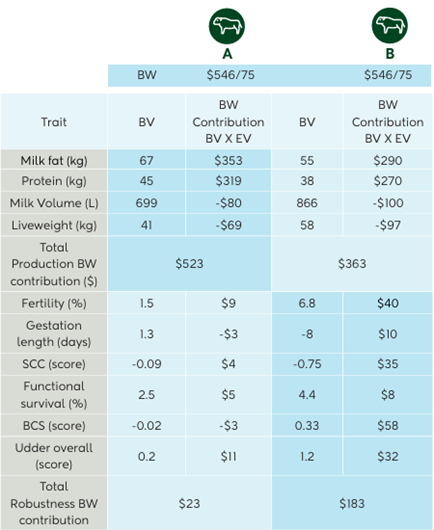
(chart source: Dairy NZ)
To sum it up, the Crossbreed cow is pretty hard to go past for a large chunk of NZ dairy farmers. The criticisms I hear of animals as they pertain to cow conformation are not the breed’s fault; it’s the application of bulls within the breed that has driven these outcomes. As a go anywhere, do anything sort of animal with a sweet spot between J12 and F12, I think the Crossbreed cow is truly ‘New Zealand’s cow’.
